Is creatine just for men? Not even close

Why does everyone think creatine is a men's supplement?
Because for thirty years that's who it was sold to. It sat next to the protein tubs, with a man flexing on the front. Nothing about creatine itself is male. Your liver, kidneys and pancreas make it, and you get more from meat and fish.
That last part matters. A 2025 review in the Journal of the International Society of Sports Nutrition found women eat 30–40% less creatine than men, and some reports show women's bodies make around 20% less. Vegetarians and vegans get very little from food at all. Yet research in women has only recently gained traction. Creatine isn't a men's supplement. It's an understudied one.
Will creatine make me bulky?
No. Creatine isn't a hormone and it doesn't build muscle by itself. It draws a little extra water into your muscle cells, so you might see a small change on the scales early on. A 2021 review of common creatine myths found this shows up in the first few days and is temporary. It's water inside the muscle, not fat.
Does creatine cause hair loss?
There's no good evidence it does. The idea comes from one 2009 study of 20 male rugby players who took 25g a day for a week, about seven times our dose. Their levels of DHT, a hormone linked to hair loss, rose. Nobody measured hair, and the result has never been replicated. If hair loss runs in your family, a quick chat with your GP will put your mind at rest.
Is creatine bad for your kidneys?
In healthy adults, research at everyday doses hasn't shown kidney harm. The worry traces back to a single 1998 case of a man who already had kidney disease. One useful thing to know: creatine can raise creatinine on a blood test, which can look alarming but is expected. Tell your GP you take it before any blood test.
How much creatine should women take?
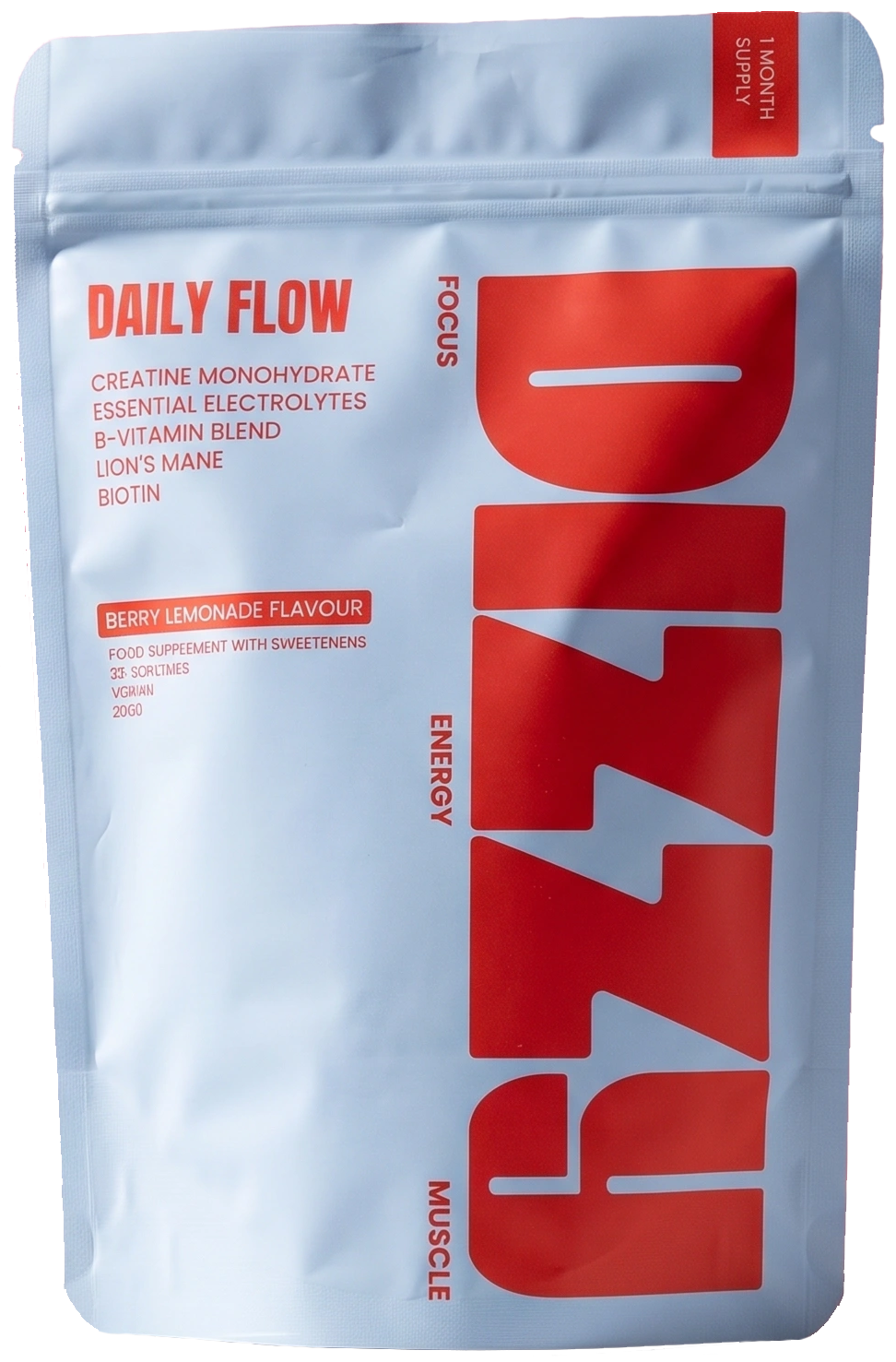
Around 3g a day is the amount the UK's authorised creatine claim is based on: creatine increases physical performance in successive bursts of short-term, high-intensity exercise. Daily Flow has 3.5g per serving. Look for creatine monohydrate, the most researched form, and take it every day.
Do I need a loading phase?
No. A 1996 study found 3g a day for 28 days raised muscle creatine by about 20%, the same as 20g a day for six days. It just took longer, and you skip the stomach trouble high doses can cause.
Who should check with a GP first?
Speak to your GP or pharmacist before starting if you're pregnant or breastfeeding, take medication, or have a kidney condition.
So who is creatine actually for?
Anyone who wants it. We built Daily Flow for full days, not just training days. You don't need a gym membership to have a reason to look at the most researched supplement ingredient there is.
Got a question we haven't covered? Try the FAQ page, email hello@dizzysupps.com, or see exactly what's in Daily Flow.
Your questions, answered
Isn't creatine just for men?
No. Creatine isn't a men's supplement. A 2025 review in the Journal of the International Society of Sports Nutrition found women eat 30–40% less creatine in their diets than men, and research in women has only recently gained traction.
Will creatine make me bulky?
No. Creatine isn't a hormone and doesn't build muscle by itself. It draws a little extra water into muscle cells, and a 2021 review found any water retention appears in the first few days and is temporary.
Does creatine cause hair loss?
There's no good evidence that it does. The worry comes from a single 2009 study of 20 male rugby players that measured the hormone DHT, not hair, and the result has never been replicated.
Is creatine bad for your kidneys?
In healthy adults, research at everyday doses hasn't shown kidney harm. Creatine can raise creatinine on a blood test, so tell your GP you take it. If you have a kidney condition, check with your GP first.
Do I need a loading phase?
No. A 1996 study found 3g of creatine a day for 28 days raised muscle creatine by about 20%, the same as 20g a day for six days. It just took longer.
Sources
- Creatine in women's health: bridging the gap from menstruation through pregnancy to menopause, Smith-Ryan et al., JISSN, 2025
- Common questions and misconceptions about creatine supplementation, Antonio et al., JISSN, 2021
- Three weeks of creatine monohydrate supplementation affects dihydrotestosterone to testosterone ratio in college-aged rugby players, van der Merwe et al., Clinical Journal of Sport Medicine, 2009
- Muscle creatine loading in men, Hultman et al., Journal of Applied Physiology, 1996
- Great Britain nutrition and health claims register, GOV.UK